Every approved Parkinson's medicine today treats symptoms. None has been proven to slow the disease itself. That's why the progress of prasinezumab — an antibody designed to target the misfolded protein at the heart of Parkinson's — is being watched so closely. In late 2025, Roche moved it into a large Phase 3 trial, and new long-term analyses were presented in 2026.
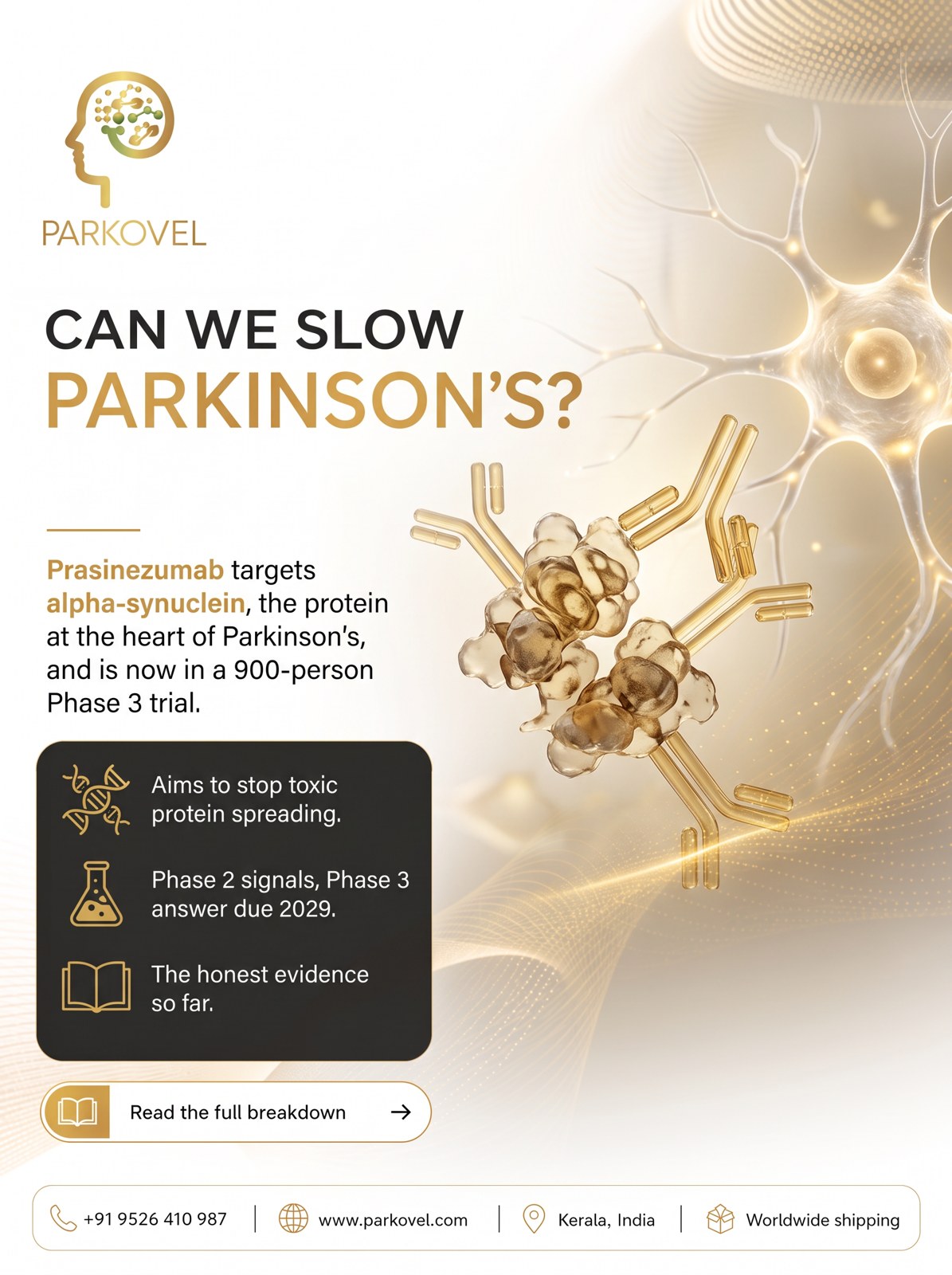
The Target: Alpha-Synuclein
Alpha-synuclein is a normal protein in nerve cells. In Parkinson's, it misfolds and clumps together, forming the Lewy bodies seen in affected brain cells. Growing evidence suggests these clumps can spread from cell to cell, which may help explain how the disease progresses through the brain over time. Prasinezumab is a monoclonal antibody — a lab-made immune protein — designed to bind aggregated alpha-synuclein and reduce that spread.
The Evidence So Far
The road has been mixed, which is common for first-of-their-kind therapies. In the Phase 2 PASADENA trial, prasinezumab did not meet its primary endpoint, but exploratory analyses suggested slower worsening of motor signs. The larger Phase 2b PADOVA trial, in people with early Parkinson's already on symptomatic therapy, narrowly missed its primary endpoint — time to confirmed motor progression — while showing consistent trends in favour of the drug across several clinical and biomarker measures. Roche's partner Prothena describes these signals as exploratory rather than confirmatory.
At the AD/PD 2026 conference, Roche presented a "time saved" analysis from the PASADENA open-label extension, estimating roughly two years of delayed progression over five years. Because open-label extensions lack a placebo comparison, this is a hypothesis-generating result, not proof.
The Phase 3 Test: PARAISO
To get a definitive answer, Roche launched PARAISO in late 2025, a Phase 3 trial that plans to enrol about 900 people with early Parkinson's. Its primary completion is expected around 2029. If it succeeds, prasinezumab could become the first therapy shown to modify the course of Parkinson's — a genuine turning point.
Why It Matters Even Before the Answer
Alzheimer's research offers a precedent: after many failures, antibodies against amyloid eventually showed modest slowing of decline and were approved. Parkinson's research is now on a similar path with alpha-synuclein. It's also part of why earlier diagnosis matters so much — disease-slowing drugs are likely to work best when started early, before extensive neuron loss.
Frequently Asked Questions
Can I get prasinezumab now?
No. It is investigational and available only within clinical trials.
Would it replace levodopa or other medicines?
No. It is being tested alongside standard symptomatic treatment, aiming to slow progression rather than relieve symptoms directly.
When will we know if it works?
The PARAISO trial's primary results are expected around 2029.
Are there other alpha-synuclein approaches?
Yes. Several antibodies, vaccines, and small molecules targeting alpha-synuclein are in development, though most are at earlier stages.
While the search for disease-modifying treatment continues, consistent symptom care — medicine, exercise, nutrition, and supportive formulations like Parkovel365 under medical guidance — helps people live well today.
Sources
- Prothena, "Prothena Reports Second Quarter 2026 Financial Results and Business Highlights" (August 2026)
- ClinicalTrials.gov, PARAISO Phase 3 study of prasinezumab (NCT07174310)
- NeurologyLive, "Previewing Parkinson Disease Pipeline: Emerging Trials to Watch in 2026"